On November 1, the 2026 New Member Welcome Exchange and Safety Training Meeting for the Chemical Process Intensification Innovation Team (CPI Group) of the School of Chemical Engineering at Tianjin University was held in Conference Room A223, Building 50. Professor Han You, on behalf of the CPI faculty, extended a warm welcome to the new members of the 2026 cohort. She introduced the team's development vision, emphasizing its consistent focus on meeting the major demands of efficient, clean, and intelligent production across China's chemical, food, light industry, and pharmaceutical sectors. The team has established a multi-scale research framework integrating "molecules – equipment – plants," with equal emphasis on fundamental innovation and engineering applications. Drawing on her research achievements in computational catalysis and reaction kinetics, Professor Han encouraged the new students to stay at the forefront of their discipline, identify clear research directions, and achieve growth and breakthroughs through rigorous and pragmatic approaches.
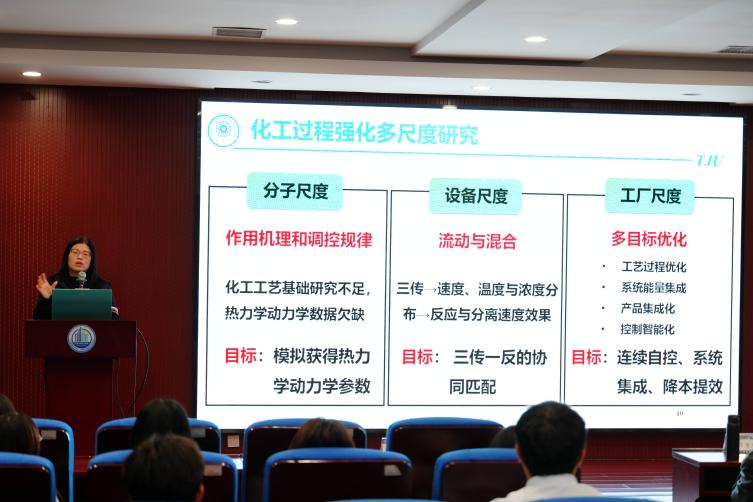
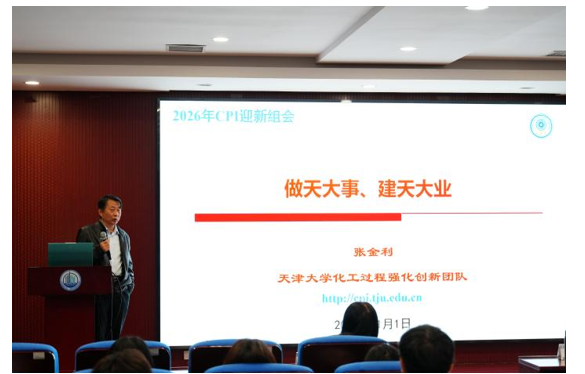
Professor Zhang Jinli shared insights around the theme of "Undertaking great endeavors and building monumental achievements." He emphasized that scientific research should be grounded in real-world problems, closely aligned with major national needs, and driven by bold innovation. Against the backdrop of rapid advancements in artificial intelligence, Professor Zhang pointed out that researchers should not merely using or calling upon AI tools superficially, but must delve deeper—exploring the underlying logic of AI, striving to create AI themselves, and leveraging artificial intelligence to empower scientific practice and enhance research efficiency, thereby truly fulfilling the mission of "undertaking great endeavors and building monumental achievements." He also underscored the critical importance of safety in scientific research and clarified the group's safety management regulations and requirements.
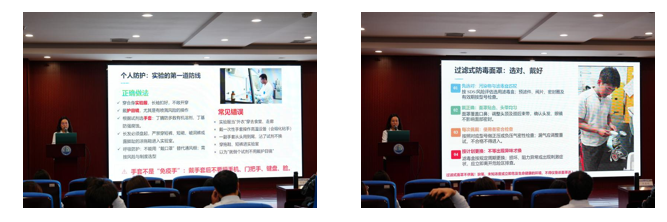
To strengthen new students' awareness of laboratory safety risks, standardize experimental practices, and integrate safety principles throughout the entire research process, Dr. Huo Xinyi conducted a specialized training session on laboratory safety and operational standards for incoming students. The training systematically covered core topics including safety access requirements, personal protective equipment (PPE), chemical and equipment management, and emergency response, guiding the 2026 cohort to abandon (lucky thinking) and uphold safety as the first line of defense in scientific research.
Regarding safety awareness and access criteria, the training used real-life laboratory accident cases from Chinese universities to illustrate how complacency—thinking "nothing will happen"—is often the root cause of incidents. It emphasized that "stop and verify if uncertain" is the fundamental principle in research laboratories. Four mandatory access requirements were established: passing a safety training assessment and signing a safety commitment letter; being familiar with the locations of emergency facilities and evacuation routes; reviewing Material Safety Data Sheets (MSDS) before using reagents to understand associated risks; and requiring senior lab members to be present during initial operations—all aimed at strictly controlling entry points from the outset.
In personal protection and chemical management, the training stressed that "personal protection is the first line of defense in the lab." It systematically reviewed protocols for wearing lab coats, eye protection, glove selection, and dress codes, correcting common misconceptions such as wearing lab coats into public areas or reusing gloves throughout an experiment. For respiratory protection, it explained the proper selection, fitting, seal checks, and scheduled replacement of filtering gas masks, clearly defining their limitations—specifically, that they do not provide oxygen. Chemical storage emphasized key rules such as separating acids and bases, isolating oxidizers and reducers, and storing solids and liquids separately. Special attention was given to the "five-dual" management system for precursors to drugs and explosives, requiring precise inventory records down to grams/milliliters and immediate return of unused reagents to ensure full traceability throughout the process.
The training integrates safety standards with research quality, proposing to "turn experiments into auditable mini-processes," and outlines standardized operational pathways across five key stages: experimental objectives, risk identification, pre-experiment checks, experiment documentation, and result verification. Regarding emergency response and safety closure, the training emphasizes that "waste liquid containers are not universal trash bins," explaining proper waste classification, labeling requirements, and storage of sharps in designated containers. It clearly defines handling principles for minor spills versus large or unknown leaks. For overnight experiments, a "six-checks-before-leaving" checklist is introduced, explicitly prohibiting five types of scenarios, requiring all overnight experiments to follow a dual-reporting system involving both supervisors and lab managers, and mandating the display of information signs indicating personnel, risks, and emergency procedures—ensuring comprehensive risk management.
This welcome exchange session serves not only as a gathering to greet new members but also as an essential introductory course on building strong safety awareness. The CPI research group will continue refining its safety protection system, helping new researchers fasten the "first safety button" of their scientific careers, uphold safety as a fundamental principle, carry forward the tradition of rigorous scholarship, and promote high-quality development of team research.